
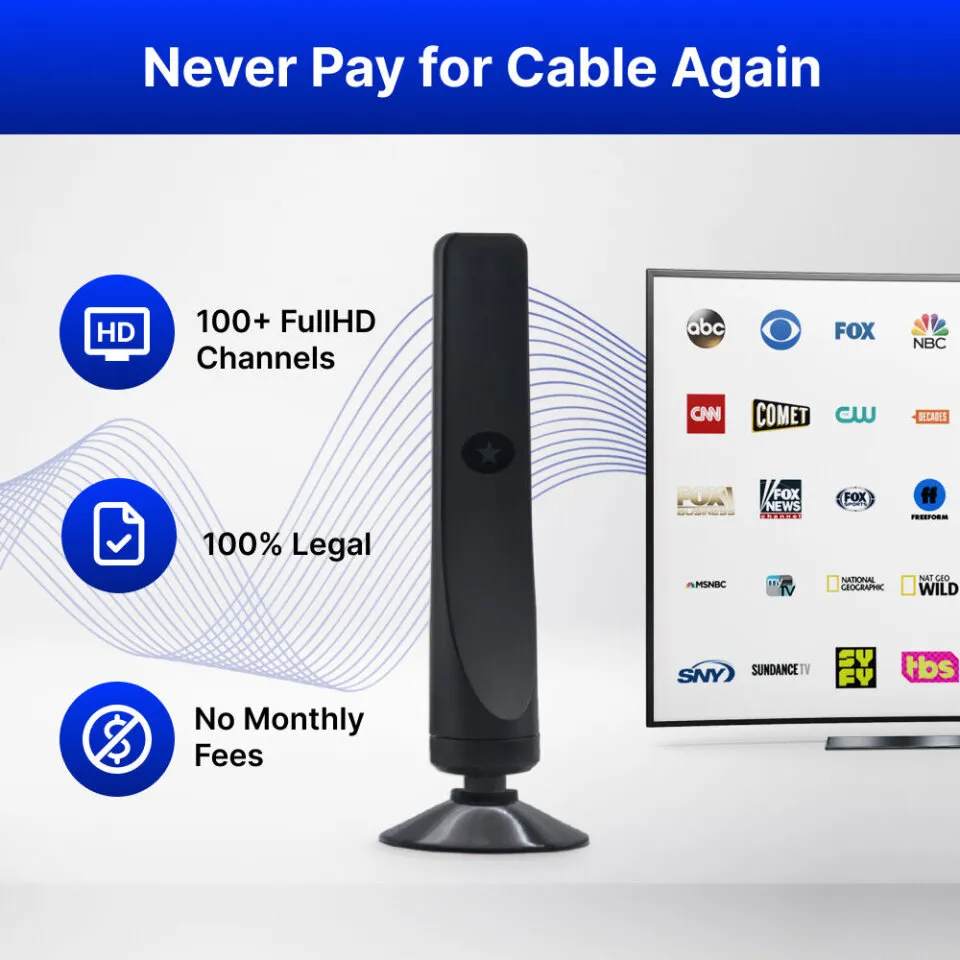
Wavemax Antenna Reviews: Does It Actually Work?
A thorough and honest look at reception quality, how many channels you can actually get, real customer experiences, and whether the Wavemax antenna is worth buying in 2026.
Wavemax TV Antenna — Quick Overview
The average American household pays over $100 per month for cable or satellite TV — a number that has climbed steadily for years while the actual amount of television people watch has shifted dramatically toward streaming. For the millions of viewers who primarily watch local news, sports on broadcast networks, network dramas, and morning shows, paying a cable company for hundreds of channels they never watch is an increasingly difficult expense to justify.
This is exactly the problem a quality TV antenna solves. The Wavemax TV Antenna has been attracting attention from cord-cutters and cable bill reducers looking for a simple, one-time investment that delivers free HD local channels indefinitely. This review tells you honestly what to expect, how many channels you can realistically get, and what real users are experiencing.
Bottom line up front: The Wavemax TV Antenna is a legitimate indoor TV antenna that receives over-the-air broadcast signals effectively. Reception quality and available channels depend heavily on your location and distance from broadcast towers — factors that affect all antennas equally. In areas with good signal strength, it delivers free HD local channels with picture quality that actually exceeds cable compression. For cord-cutters and supplemental antenna users, it represents excellent value.
Stop Paying $100+ a Month for Channels You Never Watch
The Wavemax TV Antenna is available through the official website. Check current pricing and any active promotions.
Check Official Website & PriceAffiliate link — we may earn a commission at no extra cost to you.
The Case for Cutting the Cable Bill
Before evaluating the Wavemax specifically, it is worth understanding the broader context. Over-the-air (OTA) TV is not a lesser alternative to cable — it is the original broadcast system that predates cable by decades, and the digital transition that occurred in 2009 actually made it better. Since the switchover to digital broadcast, over-the-air HD signals are transmitted uncompressed, meaning the picture quality you receive via an antenna is often superior to the same channel on cable or satellite, where signals are compressed to fit more channels into available bandwidth.
What an antenna provides:
- All major local broadcast networks: ABC, NBC, CBS, FOX, PBS, The CW, and more
- Local news and weather — often in better HD quality than cable delivers
- Network sports — NFL, college football, NBA Finals, World Series, golf, Olympics
- Network primetime programming — the most-watched shows in America air on broadcast networks
- Dozens of sub-channels with free content including movies, classic TV, and specialty programming
What an antenna does not provide: cable-only channels like ESPN, HBO, CNN, HGTV, and other subscription-based content. For viewers whose primary TV use is local channels and broadcast network programming, the savings versus cable are immediate and substantial.
What Is the Wavemax TV Antenna?
The Wavemax TV Antenna is an indoor digital TV antenna designed to receive over-the-air broadcast signals and deliver them to your television in HD quality. It connects to your TV’s antenna input (the same RF coaxial connector used by cable) and works with any modern television’s built-in digital tuner — no additional equipment or subscription required.
The antenna is designed for easy placement in a variety of home environments — near a window, on a wall, or behind the television — and requires no professional installation. Once connected and a channel scan is completed, your TV displays all available free broadcast channels in your area.
How Does the Wavemax Antenna Work?
TV antennas work by receiving the electromagnetic radio waves broadcast by local television transmitters and converting them into electrical signals that your TV can process. In the digital era, these signals carry MPEG-compressed HD video — the same content that cable systems receive from the broadcaster and then recompress before sending to subscribers.
UHF and VHF Bands
Modern broadcast TV uses two frequency bands. VHF (Very High Frequency, channels 2–13) requires a physically larger antenna element for optimal reception. UHF (Ultra High Frequency, channels 14–36) is received more effectively by compact indoor antennas. Most major broadcast channels in most American markets transmit on UHF, which means quality indoor antennas are effective for the majority of users. Some PBS and CW affiliates transmit on VHF, which can be more challenging for compact indoor antennas in marginal signal areas.
Signal Amplification
The Wavemax antenna includes a built-in amplifier designed to boost weak signals before they reach the TV’s tuner. Amplifiers are beneficial in areas where signal strength is borderline — they can make the difference between a pixelating picture and a stable HD signal. However, in areas with very strong signals or significant signal interference, amplification can sometimes cause overload — a condition where the signal is too strong and causes distortion. Most users in typical suburban and urban environments find amplification beneficial.
What Channels Can You Get With the Wavemax Antenna?
This is the most important practical question, and the honest answer is: it depends entirely on where you live.
The FCC’s free tool at tv.fcc.gov/maps allows you to enter your address and see exactly which broadcast channels are available in your area and from which direction the transmitters are located — information that is far more useful for setting expectations than any marketing claim.
| Location Type | Typical Channels Available | Reception Outlook |
|---|---|---|
| Major metro area (within 30 miles of towers) | 25–60+ channels | Excellent — strong signals across all major networks |
| Suburban (30–50 miles from towers) | 15–35 channels | Good — most major networks with stable reception |
| Rural (50–75 miles from towers) | 5–20 channels | Variable — depends on terrain and transmitter power |
| Remote (75+ miles from towers) | 0–10 channels | Limited — outdoor antenna may be more appropriate |
Sub-Channels: The Hidden Bonus
Most viewers do not realize that modern digital broadcast channels include multiple sub-channels — additional programming streams on the same frequency. Your local NBC affiliate broadcasting on channel 5 may also carry 5.2 (MeTV with classic TV shows), 5.3 (Heroes & Icons), and 5.4 (Ion Mystery). In many markets, an antenna delivers 40 to 60 unique channels including these sub-channels — far more than most users expect before trying it.
Free HD TV Starts With the Right Antenna
The Wavemax antenna delivers local broadcast channels with no monthly fees — ever. Check current pricing on the official website.
View Current Pricing on Official SiteAffiliate link — we may earn a commission at no extra cost to you.
Wavemax TV Antenna: Pros and Cons
Pros
- Free HD channels — no monthly fees after purchase
- Picture quality often better than cable (uncompressed broadcast)
- Simple installation — no tools, no professional needed
- Works with any TV with a coaxial antenna input
- No contract, no subscription, no cancellation hassle
- Dozens of channels including sub-channels in most markets
- Built-in amplifier for improved weak signal reception
- Satisfaction guarantee available
Cons
- Cannot receive cable-only channels (ESPN, HBO, etc.)
- Reception depends on distance from broadcast towers
- Indoor antennas less effective than outdoor in fringe areas
- Building materials (concrete, metal) can reduce reception
- Antenna placement may require experimentation
- Only available online — not in stores
Reception Performance: Honest Expectations
Reception is the factor that most determines satisfaction with any TV antenna — and it requires honest discussion rather than marketing optimism.
The Distance Factor
All indoor TV antennas — regardless of brand or claimed range — are fundamentally limited by the laws of physics and the power of local broadcast transmitters. Claimed range figures (50 miles, 100 miles, 120 miles) are typically measured under ideal open-field conditions and rarely reflect real-world indoor performance. A realistic rule of thumb for most indoor antennas: reliable reception within 35 to 50 miles of broadcast towers in suburban environments, with performance declining in rural areas, inside buildings with metal construction, or in areas with significant terrain obstructions like hills.
The Picture Quality Advantage
One aspect of antenna TV that surprises most users: the picture quality. Because broadcast HD signals are transmitted uncompressed at full bitrate, the native broadcast signal carries more picture data than the same channel on cable or satellite — where providers compress signals to fit their bandwidth. Many users who switch to an antenna comment that their local channels look noticeably sharper than they did through cable. This is not marketing — it is a direct consequence of how digital broadcast transmission works.
Placement Is Critical
The single most important factor in indoor antenna performance after signal availability is placement. Antennas perform best near windows, on exterior walls, or in elevated positions within the home. Basements and interior rooms with thick walls are the most challenging environments. Most users find that experimenting with placement — particularly height and proximity to windows — makes a meaningful difference in the number of channels reliably received.
Real Customer Experiences With Wavemax Antenna
We reviewed a wide range of verified customer feedback. Here is an honest picture of what users consistently report:
I was paying $147 a month for cable and watching maybe four channels regularly — all local networks. I bought the Wavemax after months of debating it and set it up in about ten minutes. I get 43 channels clearly including all the major networks in full HD. The picture quality on my local CBS affiliate is actually better than it was through cable — sharper and more consistent. I cannot believe I waited this long. That cable money goes toward streaming services now and I am spending about $50 less per month overall.
— Linda K., verified buyer · Columbus, OHWorks great for most channels. I am about 40 miles from the nearest broadcast towers and I get ABC, NBC, CBS, FOX, and PBS reliably plus about 20 sub-channels. My one note is that I had to experiment with placement — the first spot I tried only gave me 12 channels, but near my living room window I get 31. Take the time to try different positions before settling. Once I found the right spot it has been rock solid for three months.
— Thomas B., verified buyer · suburban MichiganI live in a rural area about 65 miles from the nearest city. I only get ABC and NBC reliably — FOX and CBS come in but they pixelate occasionally. I knew going in that rural reception would be limited, so I am not surprised. For $0 per month after the initial purchase I get the two networks I care most about in decent HD, which is still a win. If you are rural, manage your expectations but it is still worth trying.
— Patricia M., verified buyer · rural IowaI bought two Wavemax antennas — one for the living room and one for the bedroom. Both work perfectly in my suburban Chicago home about 25 miles from the city towers. I get 54 channels total. The NFL games look incredible — better than they did on cable, honestly. I still pay for one streaming service for the content that is not on broadcast, and between that and zero cable bill I am saving over $80 a month. Highly recommend for anyone in a metro or suburban area.
— Kevin R., verified buyer · suburban Chicago, ILCommon Themes in Customer Feedback
- Picture quality praise — users consistently comment that broadcast HD is sharper than cable
- Placement experimentation is key — nearly all satisfied users tried multiple positions before finding the optimal spot
- Rural limitations are acknowledged honestly — users who researched their local signal availability before buying are consistently more satisfied
- Significant monthly savings — the financial motivation is strong and delivered for the majority of buyers
- Sub-channel discovery — many users are pleasantly surprised by the number of channels available
Join Millions of Americans Who Have Already Cut the Cable Bill
See why the Wavemax TV Antenna has become the cord-cutter’s choice for free local HD television. Check current pricing and bundle options now.
Visit the Official Wavemax WebsiteAffiliate link — we may earn a commission at no extra cost to you.
How to Install and Optimize the Wavemax Antenna
Installation is one of the most straightforward aspects of the Wavemax antenna. Here is the step-by-step process for best results:
- Check your local signal availability first — visit tv.fcc.gov/maps and enter your address to see which channels are available and from which direction the transmitters are located
- Connect the coaxial cable to your TV’s Antenna/Cable RF input — the same port used for cable
- Position the antenna near a window facing the direction of your broadcast towers if possible, or on an exterior wall at the highest point you can manage
- Run a channel scan on your TV (typically found in Settings > Channels > Auto Scan or similar)
- If results are unsatisfactory, experiment with placement — move the antenna to different windows, different heights, and different rooms and re-scan each time until you maximize channel count
- For fringe signal areas — try positioning the antenna in a window on the same side of the house as your broadcast towers and as high as possible
One practical tip: the amplifier included with the Wavemax can sometimes cause signal overload if you are very close to strong broadcast towers. If channels that should receive strongly are pixelating or dropping out, try disconnecting the amplifier and connecting the antenna directly to the TV.
Wavemax Antenna vs. Cable and Streaming
This comparison helps clarify where the Wavemax fits in a modern entertainment setup:
| Factor | Wavemax Antenna | Cable TV | Streaming Only |
|---|---|---|---|
| Monthly cost | $0 (one-time purchase) | $80–$200+/month | $15–$60+/month |
| Local news and weather | Yes — all local networks | Yes | Limited — often delayed or unavailable |
| Live sports (broadcast) | Yes — NFL, MLB, Olympics, etc. | Yes | Limited — often requires premium add-ons |
| Picture quality (local channels) | Best — uncompressed broadcast HD | Good — compressed HD | Variable — depends on bandwidth |
| Cable-only channels | No | Yes | Through subscriptions |
| Internet required | No | No | Yes — essential |
The most effective cord-cutting strategy for most households: Wavemax antenna for free local channels and broadcast sports, combined with one or two selective streaming subscriptions for cable-style content. This approach typically reduces total monthly TV spending by $60 to $100 compared to a full cable package.
Where to Buy the Wavemax TV Antenna
The Wavemax TV Antenna is available through the official website. Purchasing directly ensures you receive the authentic product with access to the satisfaction guarantee and any current promotional pricing. Multi-unit options are sometimes available for households wanting to connect multiple TVs.
Some third-party listings may exist on Amazon, but the manufacturer recommends the official website for product authenticity and full guarantee coverage.
Our Verdict on the Wavemax TV Antenna
The Wavemax TV Antenna earns a solid recommendation for cord-cutters, cable bill reducers, and anyone who watches primarily local broadcast content. In suburban and urban environments within 50 miles of broadcast towers, it reliably delivers free HD local channels with picture quality that often exceeds cable. The built-in amplifier helps in marginal signal areas, and installation takes less than fifteen minutes.
Reception in rural areas is more variable — a limitation shared by all indoor antennas and determined by the physics of broadcast signal propagation rather than product quality. Buyers who check their local signal availability before purchasing and set appropriate expectations based on their location consistently report satisfaction. With no monthly fees and a satisfaction guarantee, the financial risk is minimal and the long-term savings for most users are substantial.
Try Wavemax Antenna — Official WebsiteFrequently Asked Questions About Wavemax TV Antenna
What is the Wavemax TV Antenna?
The Wavemax TV Antenna is an indoor digital over-the-air antenna that receives free HD broadcast signals from local TV networks including ABC, NBC, CBS, FOX, PBS, and others — with no monthly subscription required.
Does the Wavemax antenna really work?
Yes, in areas with available broadcast signals. It receives over-the-air digital TV signals as effectively as any quality indoor antenna. Reception quality depends on your distance from broadcast towers and local geography.
Is the Wavemax antenna a scam?
No. It is a legitimate TV antenna. Negative reviews typically come from users in areas with poor broadcast coverage or who expected cable-channel reception — limitations that apply to all indoor antennas equally.
What channels does the Wavemax antenna receive?
All available over-the-air broadcast channels in your area — typically ABC, NBC, CBS, FOX, PBS, The CW, and dozens of sub-channels. The exact number depends on your location. Use the FCC’s signal map at tv.fcc.gov to check what is available at your address.
Does Wavemax work for live sports?
Yes for broadcast sports — NFL games on FOX, CBS, and NBC; college football; MLB; Olympics; golf; and other sports that air on broadcast networks are all free with the antenna. Cable-only sports channels (ESPN, FS1) are not available via antenna.
How do I install the Wavemax TV Antenna?
Connect the coaxial cable to your TV’s antenna input, position the antenna near a window, run a channel scan on your TV, and watch free HD channels. No tools or professional installation required. Placement experimentation significantly affects results.
How many channels will I get?
It depends entirely on your location. Urban users within 25 miles of broadcast towers typically get 30 to 60+ channels. Suburban users at 30 to 50 miles typically get 15 to 35. Rural users at 50+ miles see more variable results. Check tv.fcc.gov for your specific address.
Is antenna TV better quality than cable?
For local broadcast channels, often yes. Over-the-air digital signals are transmitted uncompressed, while cable providers compress signals to fit their bandwidth — resulting in less picture data. Many users find their local channels noticeably sharper after switching to an antenna.
Does Wavemax work in apartments?
Yes, in most cases. Apartments in urban and suburban areas typically receive strong signals. Upper floors perform better than lower floors due to reduced obstructions. Placing the antenna near a window facing the direction of broadcast towers is recommended.
Does Wavemax require internet?
No. The antenna receives broadcast TV signals over the air with no internet connection required.
Is Wavemax worth buying?
For viewers in suburban and urban areas who primarily watch local channels and broadcast network content, yes — it eliminates monthly cable fees and often delivers better picture quality. Check your local signal availability before purchasing to confirm it will work in your area.
Where can I buy the Wavemax TV Antenna?
The Wavemax TV Antenna is available through the official website. Purchasing directly ensures product authenticity, access to the satisfaction guarantee, and the best available pricing.
Make an Informed Decision
You have done your research. If the Wavemax TV Antenna sounds right for your location and viewing habits, the official website is the best place to start.
Get Wavemax Antenna — Official SiteAffiliate link — commission earned at no extra cost to you.
Affiliate Disclosure
This article may contain affiliate links. If you purchase a product through one of these links, we may earn a commission at no additional cost to you. This helps support our website and allows us to continue providing independent reviews and informational content. Our recommendations are based on publicly available information, product research, and editorial analysis.
Results Disclaimer
The experiences and testimonials referenced in this article are individual experiences and may not reflect the typical results of all users. TV antenna reception depends on location, distance from broadcast towers, local terrain, building construction, and antenna placement.
Advertising Disclosure
This website participates in affiliate marketing programs. The compensation received may influence the placement of links within the content but does not affect our editorial standards or product evaluations.
Information Accuracy
We make every effort to ensure information is accurate at the time of publication. Product specifications, pricing, availability, and policies may change without notice. Always verify details directly on the official manufacturer website before purchasing.
Editorial Policy
Our goal is to provide helpful, research-based content that assists consumers in making informed decisions. Content should not be interpreted as professional advice of any kind.